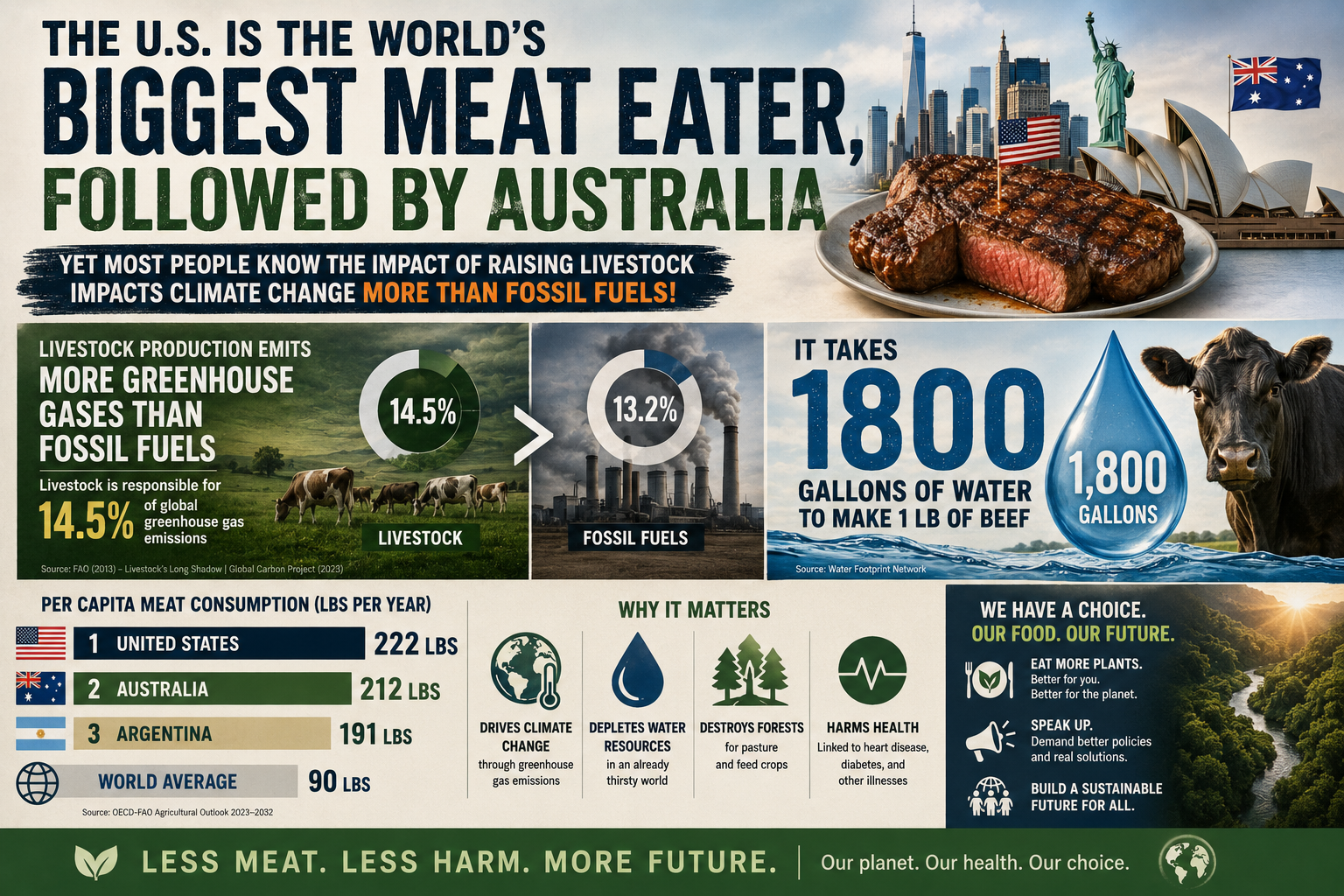

There are solutions: burgers: made from plants are delicious and aren’t killing the climate. Anyone notice recent weather changes: 116 degrees in Portugal 10 days ago! 27 feet of rain in 90 minutes in Texas, resulting in 100+ deaths.
Climate change does not feel like a hoax to those families who lost their only child at the Mystic camp, or the family that lost their grandmother, who could no longer hold on to a tree branch with a 27 ft wall of water barreling down on her.
We are saddened by this terrible disaster and yet are hopeful for change to halt some of the climate impacts, while there is still time. If people give up meat one day per week, it is equal to taking 6-8 million gas guzzling cars off the road, if we all did this in the U.S. just one day/week for one year!
Be the change! (sign our Meat Down Pledge on our website)
See our veggie recipes, every Friday, sign up on our website – https://climatediet.org/ & receive them by email on Fridays. Recipes show how many greenhouse gases are saved by making the plant-based recipe!
Thanks to all those who have made the change to….”Eat smart to save our planet.” Jane DeMarines, Executive Director, Climate Diet
National Climate Report Website Goes Dark

“The government website that hosted the federal government’s national climate reports, which are mandated by legislation, went offline Monday afternoon. The website was also one of the main federal sources of information on climate change.” Rebecca Dzombak reports for the New York Times July 1, 2025.
Trump Administration Wants To Axe All Of NOAA’s Climate Research

“The Trump administration wants to zero out climate research at the National Oceanic and Atmospheric Administration (NOAA), according to a newly released budget document.” Rachel Frazin reports for The Hill July 1, 2025.
Shrinking EPA Could Make Wildfire Smoke More Dangerous

Air quality scientists worry that EPA’s demise will make it difficult to get air quality information to people. EPA uses data collected at all levels of government to forecast air quality and then broadcast the results. Public health will suffer if information is not received.” Izzy Ross and Matt Simon report for Grist June 24, 2025, in Interlochen Public Radio.
Photo Essay: Tohono O’odham Families Carry On Sacred Saguaro Fruit Harvest

“The saguaro cactus is the iconic plant of the Arizona borderlands, and in June and early July, its thorn-covered small fruit ripens. For members of the Tohono O’odham Nation, whose ancestors have lived in this hot desert for thousands of years, harvest time for the ‘bahidaj’ is sacred.” Ross D. Franklin and Giovanna Dell’Orto report for the Associated Press July 2, 2025.
Solar Industry Says Senate Plan Would Cede Production to China “A revival of U.S. solar

Solar Industry Says Senate Plan Would Cede Production to China “A revival of U.S. solar panel manufacturing that began during the first Trump administration could end with the phasing out of tax incentives for clean energy.” Ivan Penn reports for the New York Times July 2, 2025.
Severe Weather problems for an Emergency Manager

John Dwyer in Champaign County, Illinois is dealing with weather extremes as federal funding is questionable. Alexia Underwood reports for Inside Climate News June 25, 2025.
June is the new July: Why intense summer heat is arriving earlier

Summer arrived with a global sizzle—June broke centuries-old weather norms from North America to Europe and Asia. Here’s the lowdown: (according to The Washington Post, (6/25/25)
- A heat season on fast-forward: Historically, the hottest time kicked in around July 10 and lasted ~5 weeks. But in 2023 it began June 13—and now, the Northern Hemisphere averaged nearly 21 °C by mid-June 2025.
- Heatwaves everywhere: Canada, the U.S. Northeast, northern Europe saw record highs. In the U.S., nearly half the population—from the Plains to the East Coast—endured a climate-change supercharged heat dome in late June.
- Deadly and damaging: European heat-related deaths are up 30% in two decades. Wildfires ignited early in Greece, and glaciers in the Swiss Alps are melting weeks ahead of schedule.
- A global trend: Japan, Mongolia, Russia, and western China recorded startling surges—some regions saw temperatures 15 °F above normal.
- Science says it’s us: Researchers say greenhouse gases are clearly making these early heatwaves 3–5 times more likely.