Food Is Climate
A Climate Diet Newsletter
October 1, 2026
This Month’s Stories
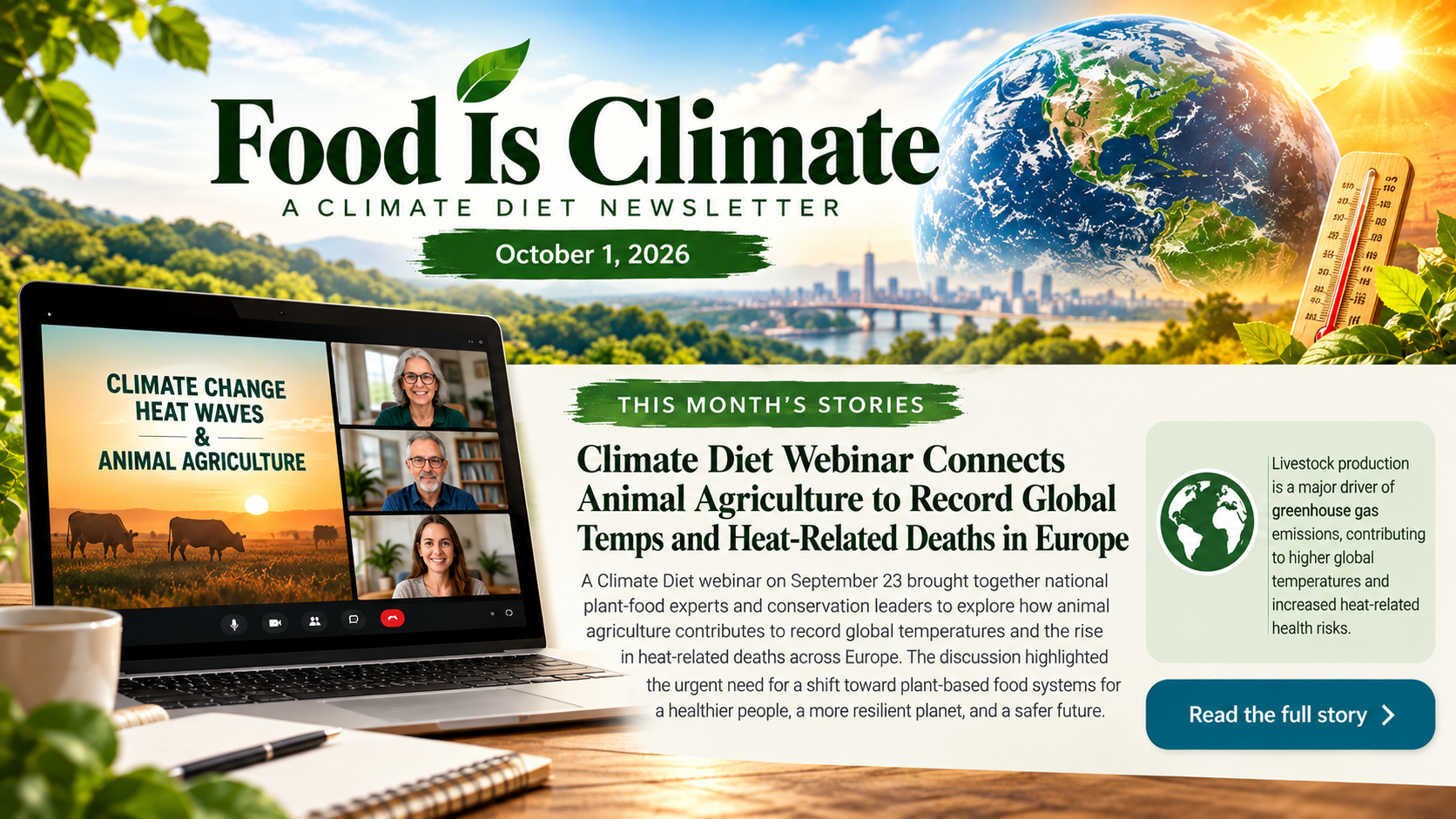
Climate Diet Webinar Connects Animal Agriculture to Record Global Temps and Heat-Related Deaths in Europe

A Climate Diet webinar on September 23 brought together national plant-food experts and conservation leaders to explore climate challenges and hopeful environmental progress. CEO Jane DeMarines highlighted record global temperatures and the 10,000 heat-related deaths in Europe this summer, while also spotlighting a hopeful data point: a 13% increase in underwater grass growth in the Chesapeake Bay. Speakers included Chesapeake Conservancy’s Andrea Ferri, who discussed forest and Bay conservation efforts, and Vegan America co-founder & CEO Jonathan Faran, who spoke about making sustainable food choices easier for consumers — Vegan America’s platform now connects 400 vegan vendors with more than 200,000 products.
Watch the complete webinar →
New Food Guidelines Increase Greenhouse Gas Emissions by Nearly 33%

A study published in Nature Food on September 23 modeled the climate footprint of the 2025–2030 Dietary Guidelines for Americans, using federal NHANES dietary data paired with life-cycle greenhouse-gas estimates. Full adherence to the new guidelines would produce an estimated 5.46 kg CO₂-equivalent per 2,000 calories — 32.8% higher than the previous two editions of the guidelines. Researchers point to the guidelines’ higher recommended protein intake as the primary driver.
🌎 Climate Diet’s take: U.S. nutrition policy and federal dietary guidance should weigh both human health and environmental consequences together — not treat them as separate questions.
Nature Food, September 23, 2026 — Read the study →
Changing Food Prices Can Shift Diets — and Potentially Emissions and Health

A new Nature Food study modeled greenhouse-gas taxes on food, with some scenarios directing the revenue toward subsidizing fruits and vegetables. Across participating food-secure countries, emissions from food consumption fell by 15–19%, while demand for ruminant meat dropped by as much as 26–47% in some scenarios. The fruit-and-vegetable subsidies also increased consumption by 1–6% and produced significantly greater health benefits, including more than 1 million potentially avoided deaths in some scenarios.
🌎 Key takeaway: pairing food policy with education — and making healthy plant foods more affordable and accessible — can support both health and climate goals at once.
Nature Food, September 21, 2026 — Read the study →
In Rural Pennsylvania, Doctors Confront Hidden Impacts of Environmental Disasters

Researchers are learning more about the long-term public health effects of living through extreme weather — especially in more isolated communities, where support and medical resources can be harder to reach.
Marie Cusick, Inside Climate News — Read the original article →
As Iran War Drives Clean Energy, It’s Not Enough to Help the Planet Yet

Countries are embracing clean power and taking steps to use less energy in response to the war against Iran — but experts say it’s not yet enough to meaningfully address climate change.
Read the complete report →
Americans Have Paid an Extra $100B for Fuel Due to Iran War

According to the Society of Environmental Journalists (week of 9/21/26), Pennsylvania’s expanding data center industry risks repeating old patterns of exploitation. A new study warns that while the industry promises economic growth and renewed industrial strength, it finds little evidence of job creation — and cautions that additional large computing complexes could continue a history of harm to nearby communities. According to the Data Center Proposal Tracker, 66 data centers could be built in Pennsylvania if all current plans proceed; five are already under construction, and five more have been approved.
Read the complete report →
Diesel Is Over $6 in 49 States: Where Prices Are Highest and Lowest

The national average diesel price has climbed to $6.51 per gallon. The highest prices are in California ($8.42), followed by Washington ($7.43), Hawaii ($7.08), Oregon ($6.87), Nevada and Indiana ($6.82), Michigan ($6.81), Illinois ($6.78), Ohio ($6.77), and Alaska ($6.67).
Read the complete report →
🌱 Plant the Future — Small Seeds. Big Change.
One dollar a month. One generation of climate leaders. Climate Diet’s Power of Food Program brings hands-on education about food, health, animals, and climate into public schools. Starting with schools in Baltimore, students learn how healthy, plant-based choices can improve their health and protect the planet. Your $1 monthly gift helps bring these lessons to classrooms and empowers the next generation to build a healthier, more sustainable future. Every dollar makes a difference.
Start Contributing — $1/Month →