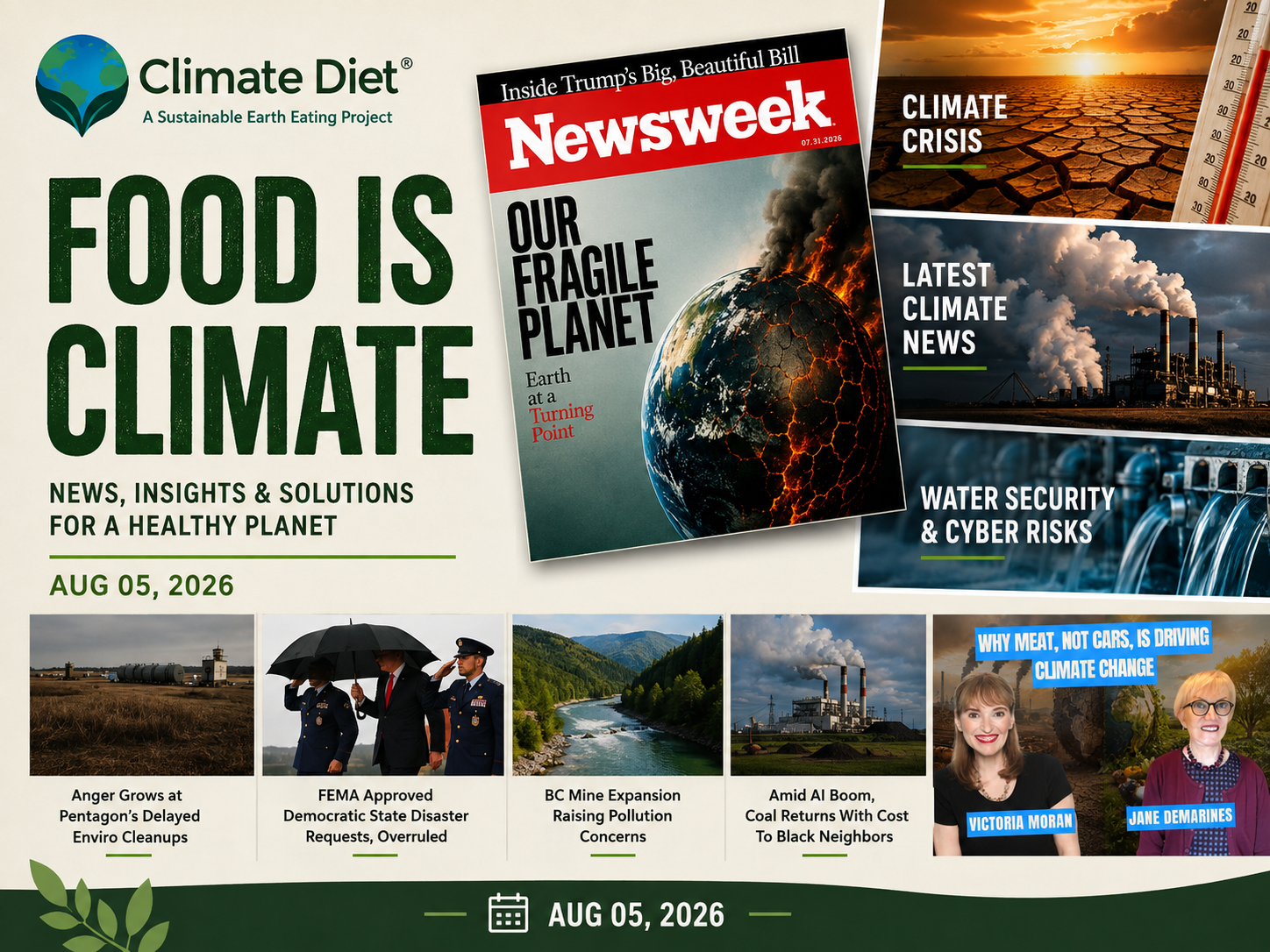
Food Is Climate
A Climate Diet Newsletter
August 5, 2026
This Month’s Stories
Climate Diet Featured in Newsweek, Highlighting the Climate Crisis

Newsweek’s July 31 edition ran a two-page feature on Climate Diet’s work raising awareness of how livestock production — and its methane emissions — contributes to climate change. The piece followed a brutal European heat wave that killed roughly 5,000 people in France as temperatures reached 116–118°F, while parts of California, Nevada, and Arizona saw highs of 120–122°F. It also examined the destruction of rainforest, especially in Brazil, to raise cattle for meat consumers, noting that the U.S. is the world’s second-largest per-capita meat consumer.
🌎 Climate Diet CEO Jane DeMarines called the coverage “a wonderful gift to the world,” saying most people remain unaware that meat consumption, in her view, has overtaken fossil fuels as the single largest driver of climate change.
Newsweek — Read the original article →
Global Warming Caused by Climate Change, Top Science Advisory Says

The nation’s top scientific advisory body has issued a report backing a growing field of science that could help governments hold oil, gas, and coal companies responsible for damage caused by extreme weather. Known as extreme event attribution, the field tries to answer an increasingly common question: how much was the latest heat wave, downpour, drought, or wildfire worsened by climate change? Scientists have long understood that greenhouse gas emissions from burning fossil fuels intensify extreme weather — now they have tools to estimate that effect for specific places and events.
Zhong, R., The New York Times — Read the full report →
Cyberattack on 30+ Minnesota Water Systems, Likely by Iran, Investigators Say

Investigators believe a cyberattack on more than 30 municipal water systems in Minnesota was probably the work of Iranian hackers, according to U.S. and state officials — a potential act of aggression coming at a precarious moment in the U.S.-Iran conflict. Officials cautioned the assessment was preliminary and could change as more technical data is collected. At least one city’s well and treatment plant went temporarily offline, and several others switched to manual operations, though no water supply was reported to be unsafe to drink.
Volz, D. & Londoño, E., The New York Times — Read the original article →
Anger Grows at Pentagon’s Delayed Enviro Cleanups

Politicians from both parties are demanding answers over stalled progress cleaning up PFAS “forever chemicals” at hundreds of U.S. military bases — contamination linked to low birth weight and other health risks. The delays have become a rare issue uniting Democrats and Republicans in criticism of the Pentagon. In December, Representative Jack Bergman of Michigan, an ally of the President, took to the House floor to praise the military’s strength, then pivoted to press the Pentagon to prioritize cleaning up PFAS pollution at sites nationwide.
Tabuchi, H., The New York Times — Read the original article →
FEMA Approved Democratic State Disaster Requests, Then Was Overruled

Regional FEMA and NOAA offices determined that New Jersey, Massachusetts, and Rhode Island met federal thresholds for disaster aid following a record-breaking February snowstorm, and the states submitted more than 150 pages of supporting documentation. Those recommendations were overruled at a higher level, adding new detail to a pattern of the administration rejecting disaster aid for states it treats as political adversaries.
Frank, T., E&E News — Read the original article →
BC Mine Expansion Raising Pollution Concerns In Canada And US

A proposed expansion of an Elk Valley Resources coal mine in southeast British Columbia is moving through the environmental assessment process despite ongoing pollution concerns. Decades of mining in the valley have already driven up selenium concentrations downstream, affecting waterways in British Columbia and the U.S. states of Montana and Idaho. Researchers and tribal and conservation groups say current mitigation efforts fall short of addressing the selenium crisis, while mine proponents point to the project’s economic contributions.
Kamnitzer, R., Mongabay — Read the original article →
Amid AI Boom, Coal Returns With Cost To Black Neighbors

The administration’s order keeping Orlando’s aging Stanton Unit 1 coal plant online is reviving environmental justice concerns over who bears the cost of AI’s growing energy demand. As data centers drive a surge in electricity use, the administration has extended the life of coal plants many utilities had already planned to retire — even though research has long shown Black communities are disproportionately exposed to coal-plant pollution and its associated health effects.
Blackmore, W., Word In Black — Read the original article →
Watch Climate Diet’s Podcast: Jane DeMarines Interviews Victoria Moran, “Why Meat, Not Cars, Is Driving Climate Change”

Vegan author Victoria Moran joins Climate Diet to discuss why animal agriculture — not cars — is a leading driver of climate change, and what a plant-based diet can do about it.
Watch the full episode →